Thursday, November 14, 2013

Harris Bilingual Elementary

Thanks to all the staff and students at the wonderful Harris Bilingual Elementary school in Fort Collins for giving me such a warm welcome!


And thanks to the lovely Laura Resau (a talented and prolific author of middle grade novels) for organizing the visit.


Lovely display of students' work - in Spanish too!


My favorite question of the day had to be -

"Are you a Princess? "

 (we had been talking about my favorite movie, BRAVE and Princess Merida! )

 Would that I were a long- ago, brave and bold Princess! 

Nico and Murphy - two students who interviewed me for community radio!

To all the staff and students, GRACIAS!

Friday, November 1, 2013

Children in Haiti

Mercy and Sharing 


Susie Krabacher is the founder of Mercy and Sharing- a wonderful organization that has been helping abandoned and disabled children in Haiti for twenty years.

Recently she sent me a few photos of the children in the orphanage reading some of my books!


Mercy and Sharing are having their first fundraising Gala on November 2nd here in Denver -Tapping into Haiti's Future    A copy of The Giant King will on every table as a table prize.  Proceeds from the Giant King benefit Child Welfare League of America and Makumbi Children's Home in Zimbabwe.

Here's to a great evening of raising money for  children in Haiti, Zimbabwe, and America!


Monday, October 28, 2013

Halloween again...

 HAPPY HALLOWEEN!

Every Halloween, it seems, I come across some students or parents who are unaware of the roots of this holiday, and so here again is my post from last Halloween for those who may have missed it.

 I love reading scary, spooky Halloween stories to children at this time of year, but I am always surprised at the number of students who are completely unaware of the roots of this holiday, and even of the derivation of the word itself.  At a recent school visit, in answer to my question about the meaning of hallow, the only child who raised his hand to answer, said, “empty,” obviously confusing it with hollow.  I suppose that is not at all surprising, given the number of people in the media who  pronounce it “Holloween.”

Ever since I came to America, I find that some teachers and parents are somewhat wary of focusing, or even of acknowledging the ghoulish aspect of this holiday, while some go so far as to maintain that it is at odds with the Christian Faith.

However, I think it provides a wonderful opportunity to talk to children about the whole notion of good versus evil.  Here is what I tell the children before I launch into my stack of spooky stories.
Halloween means Holy Evening from the old English- Hallow – Holy, and een – contraction of eve or evening.   Of course, as most people know (or at least I think they do), this holiday has its roots in the ancient Celtic/Druid/ belief that this was the time of year when evil sprits roamed the earth. In order to keep the dark forces at bay, people dressed up in costumes to “fool” the wandering souls.  With the advent of Christianity, the Celts still retained many of their ancient rituals (jack o lantern to ward off the evil sprits, dressing up in costumes and going from house to house – guising) and simply blended them into their new found Christian practices – going to Mass to celebrate the lives of the Saints and offering up special prayers for the dead.  Incidentally, the reason St. Patrick was so successful at bringing Christianity to Ireland, was that the Celtic people were already completely attuned to the idea of “other worlds” – Heaven and Hell, because they already believed in the “little people,” and they already knew that often times that which you cannot see is actually more real than what you can see.

On this Hallowed night then, I think it is good to read a ghost story or two, because the next day on the glorious feast of All Saints (one of my favorite holy days), I know that I will say a special prayer to all those “big” saints like Patrick and Joseph, Teresa and Bridget who filled this world with their goodness and grace and light.  And I will pray also to all those “little” saints – all those holy men and women who have touched my life with their particular goodness, grace, and light – my mum and my dad, all my dear Irish aunties and uncles, and even those wonderful writers, like C.S. Lewis, Madeleine L’Engle, and Thomas Merton, whose words continue to feed and nourish me.
To miss this opportunity of sharing with children that we know without a shadow of a doubt that goodness and grace will always trump the forces of evil and darkness, would indeed make this a very “hollow” festival!  So, light the lanterns, tell the spooky tales, don the wizards’ robes and witches’ hats, and have a 

                    Happy HALLOW  - EEN!
This book by Jenny Nimmo is an all-time favorite with kids at schools - very scary story from Scotland, with a great ending that beautifully illustrates the power of grace and goodness over the forces of evil!  Great for grades 5 and up.


Thursday, October 10, 2013

Bock Book Award

What a Wonderful Way to celebrate

THE FEAST OF ST. FRANCIS


Lois and I were the recipients of the Fourteenth Annual Bock Book Award presented on the feast of St. Francis to authors/illustrators whose books -

"embody Franciscan reverence for all creation which appeals to a child's sense of wonder."


The students at Neumann University prepared well for our visit with an impressive array of artwork and activities all along the corridors.


Display showing different ways that artists SEE the world


Students from nearby Drexel Elementary showing how they SHINE like the sun!


For a complete list of previous Bock Book Award Winners click 
here


Thanks to Neumann University for such a wonderful event!


Friday, September 13, 2013

Quiet 3


QUIET 3


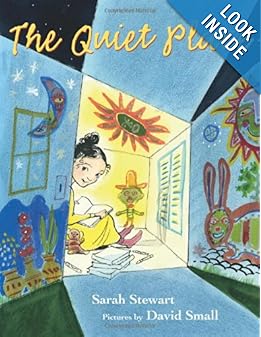
THE QUIET PLACE is a beautiful, tender tale of  Isabella and her family who move to the US from Mexico.  Isabella misses all that she has left behind, especially her Aunt Lupita and the sound of her own language.   In America she experiences her first snowstorm and she turns a large box into her QUIET PLACE, where she keeps her books and toys and writes letters to Aunt Lupita.  In her box, she feels safe and at home, and learns to adapt to her new life.  Set in the 1950’s and told through Isabel’s letters to her aunt, this is a story of immigration and assimilation.

I read this story (at the school where I read stories and majority of children are Hispanic)  in May at the close of the school year.  I had planned on reading it only to the 1st through 4th grades, but….I recognized after the 2nd or 3rd reading, that this was not only a timeless tale, but an ageless one.  The 8th graders sat as spell bound as the 1st graders.

I loved this story, not just because it is exquisitely illustrated and touchingly told, but because it opens up so many issues near and dear to my own heart.
Even although I was an adult when I moved to States, I still experienced (sometimes still do) a deep longing for my native land….homesickness.  I too missed my “language” (Scots English is different from American English).  I too missed my family back in Scotland and Ireland.  And I too missed my history, my roots, my identity.
This book also addresses what Doris Lessing (British novelist, who grew up in Zimbabwe and won Nobel Prize for Literature in 2007) calls – SPACE.  When reporters asked Lessing about her writing process, she told them that the essential question to ask any writer was not how they wrote, with quill or pen or word processor, but rather, “Have you found a space?"
because, Lessing claimed, " into that space, which is a form of listening, the ideas will come.”


 Dictionary definition of QUIET
1.       An absence or near absence of noise
2.       Peaceful, calm, tranquil
3.       Untroubled
4.       Not busy
5.       Not public
6.       Secret
7.       Modest
From the Latin – past participle – quietus, from quierscere TO REST.

QUIET books, like quiet people, teach us how to LISTEN.  It is not only writers who need SPACE, all of us do….and most especially, our little people need SPACE – QUIET PLACES
Be it a big cardboard box,
A spot underneath the table,
A den at the bottom of the yard,
A grassy patch beneath an oak tree

In their SPACE, children can pause and ponder and wonder and...
REST awhile, 
They need REST in order to GROW.

“There is nothing so strong as gentleness, and there is nothing so gentle as real strength.” Francis de Sales (patron saint of writers)

QUIET LEADERSHIP is not an oxymoron.”  Susan Cain.

Shh….Shhh….Shhh……


Friday, September 6, 2013

QUIET 2


QUIET - 2


Two schools of thought seem to surround  QUIET.

For some, “QUIET!” sounds like a stern admonition to cease and desist from all things fun and noisy.

For others, “QUIET!” sounds like balm for the soul – a blessed relief from the barrage of busy noise that assails them on all sides.

And the same opposing views surround the whole issue of QUIET books.

Some editors and agents malign QUIET books.   “Too quiet,” is a common reason for rejecting a manuscript.  Quiet books don’t sell well, they say.  Publishers want books with more action, more drama, more excitement – all of which will sustain attention spans, warrant multiple readings, and of course, sell more books!  Or so the theory goes!

There are others (myself included) who believe in QUIET books.  

QUIET books, like the state of QUIET itself, have power.  

What they lack in excitement and suspense, they compensate for with poignancy, with moments that make us pause, ponder, and wonder. Pondering and wondering are fast becoming obsolete in this age of Google, where the greatest sin of all is to admit,

 “I don’t know.”

Good stories can remind us that not all things can or should be Googled.  Not all things can or should be measured.  Our world brims with mystery and wonder and often the best response to such mystery is……SILENCE.

We all have experienced times in our lives when words fail us. In the face of immense beauty or gut-wrenching tragedy, words seem out of place, like an unwelcome guest.  A priest friend of mine says that when people are in the midst of grieving and sorrow, we should not even try to utter words, for there are none that can possibly comfort.  Instead, we should bring only our silent presence –

 hover, hush, and hug. 

  Not an easy thing to do in our culture that clamors for answers to the mystery of suffering!

Our world has led us to believe that busy is good, that the hum of voices, and the clatter of tools equates with productivity. But remember what Socrates warned, 

“Beware of the barrenness of a busy life.”

 We link work with a tangible, quantifiable product.  We are more comfortable with that which can be measured, defined, and quantified, than something more elusive, such as an idea simmering or an image being created.

It's interesting to note that Americans use the word, VACATION for that period of non-working time, whereas I grew up in Scotland using the word, HOLIDAY.

VACATION - comes from the Latin, VACARE, meaning to empty.
HOLIDAY - comes from the Old English, HOLY DAY ( a time to RE-CREATE).  Hmm, different ways of looking at the whole issue of being versus doing.

We are human BEINGS, not DOINGS, so we do need to find time to BE so we can DO. 


“The Quiet Book,” by Deborah Underwood is a beautiful example of the power of QUIET.  With spare, poetic text, and enchanting illustration, this book explores the different kind of quiets that fill a child’s day from morning to night.  There is no dramatic storyline, no plot twists and turns, no specific characters, no huge excitement – it is a quiet book about all things quiet from a child’s perspective….and it is a New York Times bestseller!  So much for quiet books not selling!

Some other quiet books that I love to read to kids.


"Life is not measured by the number of breaths we take, but by the number of moments that take our breath away.”  ANON


Friday, August 30, 2013

QUIET - 1


QUIET


I’ve always had a penchant for all things QUIET: quiet people, quiet places, quiet music, quiet walks, and quiet books, to name but a few.
Recently, I’ve read three books on QUIET  that warrant some reflection, especially from a storyteller’s perspective.


Front Cover


 A word or two (well actually a whole blog spot) on each!

“Quiet” by Susan Cain

The book’s appeal for me lies in the author’s ability to write with deep passion and humor on so many issues that I have often thought about – fleetingly, but have never taken the time to reflect or ponder upon more deeply – until now.I used to explain my predilection for all things QUIET to the noisier members of my family and friends by claiming a bit of fairy blood.  All Scots/Irish people know that fairies hate noise.
   (One of my favorite read-alouds on this is The Woman who Flummoxed the Fairies – an old Scots tale retold by Heather Forest). 

Of course, noisy skeptics (and maybe even a few quiet ones) might scoff at such airy fairy musings.  But in "Quiet", Susan Cain frequently alludes to the fact that many cultures are quieter than others.  Needless to say, America is right at the top of the noisy/loud/extrovert ladder, whereas we Scots/Irish are a little lower down!
The whole premise of the book is that introverts, who she defines as “quiet people who prefer listening to speaking, who create, but dislike self-promotion, and who prefer to work on their own rather than in  teams, have long been undervalued in our society.  She explores how extroverts have come to dominate our culture, she challenges us to see the value of silence and solitude, and she encourages us to offer kids in schools more QUIET time. 

  “Quiet leadership is not an oxymoron,” she says.
Hmmm…talk about singing to the choir!

After reading this book, I am more grateful than ever for my Scots/Irish childhood.  I grew up in a culture that valued all things QUIET. 

When I was a wee girl, my dad would always press his fingers to his lips and warn me to tread lightly as we passed by a lone bush in the fields of Ireland, lest we frighten off the fairy folk who would be hiding there. 

On winter mornings, when my dad came to wake us from our sleep, he would always whisper, so as not to disturb the hallowed hush of a new day dawning.

And as a young teacher in Scotland, I learned early on from an older, wiser colleague, that the best way to tame a rowdy class, was simply to start talking in a very low, soft voice.  Pretty soon a hush would descend, as the children strained to hear what I was saying.  Curiosity trumped the need to chatter!

In public places Scottish people speak much more softly than their American counterparts.  When we took our daughter back to visit Scotland, we ate lunch at a pub in the countryside.  Halfway through the meal, she leaned over and whispered to my husband and me, “This is like eating in a library!” (She had been raised in the era where libraries were actually places of QUIET!)

Thinking by talking aloud (a common practice in American culture) is frowned upon in Scotland. “Don’t talk the arms out of a waistcoat!” was a frequent admonition to the more loquacious members on a board or committee! 

The Scots subscribed to that old adage, “children should be seen and not heard,” and while that notion is somewhat outdated now (and rightly so), it did hold some merit.  As the youngest child, I spent many hours sitting on the edge of adult conversation, just listening. 

All of these cultural factors really served as my storyteller’s apprenticeship.  

So, how can we encourage our little ones to seek out more QUIET time, to value silence and listening and spend more time BEING versus DOING?

By basking in stories of course…..good stories that leave room for pondering and reflection, wonder, and mystery.

Coming soon - QUIET 2!